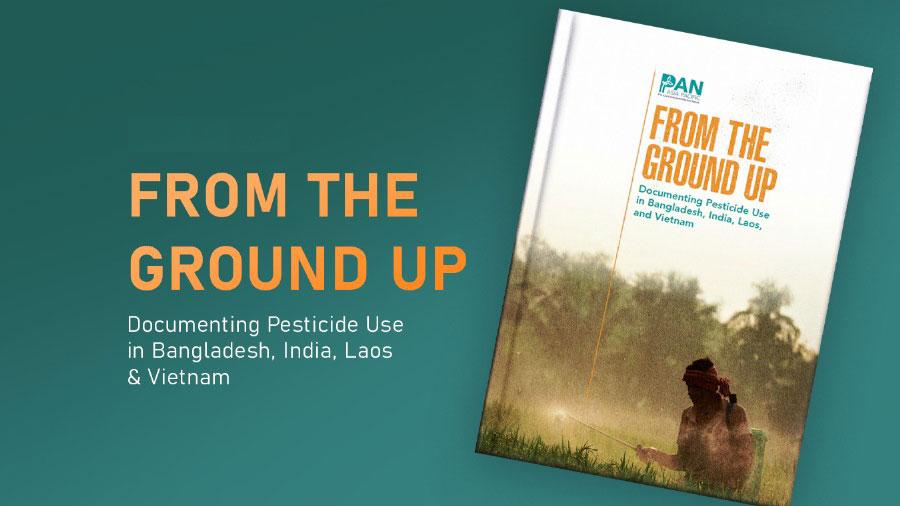
PAN Asia Pacific (PANAP) releases its new report, From the Ground Up: Documenting Pesticide Use in Bangladesh, India, Laos & Vietnam, exposing alarming levels of pesticide exposure faced daily by farming communities across the four countries. The report underscores that the right to health, safe food, and a safe environment is being systematically undermined in rural Asia. A total of 4,392 farmers were surveyed across the four countries covered in this report.
The report reveals that many farming families have lived with pesticide use for decades, may potentially resulting in chronic and cumulative exposure. Most communities are located within one kilometre of sprayed fields, meaning that women, children, the elderly, and non-farming residents are routinely exposed to drifting pesticide sprays and residue in soil, air, and water. What is commonly described as “occupational exposure” is, in reality, widespread community exposure.
The findings illustrate the severity of the problem: out of 96 pesticides identified in the survey, 53 were Highly Hazardous Pesticides (HHPs), including chemicals banned or restricted under the Stockholm Conventions as well as pesticides listed under the Rotterdam Convention for information-sharing because they are banned or severely restricted in some countries. These include chlorpyrifos, known for harming the developing brains of children; carbofuran, monocrotophos, and methyl parathion, which are listed under international treaties. Other pesticides were also detected, including paraquat, which is associated with Parkinson’s disease; atrazine, classified as probably carcinogenic to humans; and glyphosate, the most commonly found pesticide in this report, which has been linked to cancer and organ damage. The presence of these chemicals across all study sites indicates areas where regulatory oversight may be insufficient and points to an emerging public health risk that requires urgent attention.
The report also documents dangerous and preventable practices that greatly heighten exposure. Farmers frequently spray pesticides against the wind and often spray randomly or without clear direction, resulting in spray drift settling on their skin, clothes, and nearby homes. Many re-enter fields within a day of spraying, despite pesticide residues lingering on crops and soil. Personal protective equipment (PPE) is seldom used and, when used, is inadequate, often limited to cloth masks or ordinary clothing that provide little to no protection. Even when pesticide labels are available, many farmers cannot read or understand them because labels are printed in non-local languages or in fonts too small to read. These combined factors create a constant environment of exposure and risk.
“Farmers and rural children are living every day with toxic risks that no one should have to endure. This is no longer just an agriculture issue; this is a human rights issue. Governments must urgently phase out Highly Hazardous Pesticides and support a transition toward agroecology,” said Sarojeni V. Rengam, Executive Director of PANAP.
The report calls on governments to phase out HHPs, adopt and enforce the International Code of Conduct on Pesticide Management, and comply with Article 3.6, which advises against pesticides requiring PPE that is expensive, uncomfortable, or unavailable, conditions that describe most rural farming contexts in Asia. It urges the establishment of pesticide-free buffer zones around schools, households, and community areas, along with stronger regulation of pesticide retailers. The report also stresses the need for pesticide industry accountability, calling on manufacturers to stop selling pesticides that require PPE and to disclose full health and environmental risks. Most importantly, it calls for increased government support for agroecology through financial assistance, training, and enabling policies.
The full report From the Ground Up: Documenting Pesticide Use in Bangladesh, India, Laos & Vietnam is available for download. The country findings are also available on PANAP’s public CPAM portal, Our Fields, Our Health: Communities Monitoring Pesticide Impacts, where communities and civil society can access CPAM data across Asia.